

How to Improve Your Credit Score: 7 Steps That Actually Move the Needle
Your credit score is one of the most important numbers in your financial life, and one of the most misunderstood. It influences the interest rate you’re offered on a personal loan, a mortgage, or a car payment. It can determine whether you’re approved for an apartment lease. And it shapes how much borrowing costs you over a lifetime.
Most Americans are paying attention: In a 2026 survey conducted for FICO, 83% of Americans said maintaining or improving their credit score is a priority this year. But most people are working from bad information: 67% think income directly affects your credit score, or aren’t sure whether it does.1 It doesn’t.
The good news is that credit scores respond to a short list of specific behaviors. Here’s what actually drives your score, and seven steps that can help you improve it: check your reports, lower your utilization, never miss a payment, build your credit history, get credit for rent and utilities, understand hard and soft inquiries, and know which score your lender is using.
What Actually Affects Your Credit Score
The FICO Score, used by 90% of top U.S. lenders,2 weighs five categories:3
| Factor | Weight | What it measures |
|---|---|---|
| Payment history | 35% | Whether you’ve paid past credit accounts on time |
| Amounts owed | 30% | How much of your available credit you’re using |
| Length of credit history | 15% | The age of your accounts |
| Credit mix | 10% | Your blend of cards, installment loans, and other credit |
| New credit | 10% | How recently and how often you’ve applied for credit |

Two things stand out. First, payment history and amounts owed together account for 65% of your score — that’s where your effort pays off fastest. Second, your income, savings balance, employment status, age, and where you live aren’t part of the score at all. And these percentages are averages across everyone — the mix that matters most for your own score may look a little different.3
For context: in FICO’s Spring 2026 report, the average U.S. FICO Score was 714, down two points over the prior year, while a record 48.1% of consumers scored 750 or above. A companion consumer survey found that 24% of respondents had paid less than the minimum or skipped a credit card or loan payment in the past 12 months due to inflation.1
1. Check All Three Credit Reports — Free, Every Week
Your credit score is calculated from the information in your credit report. If the report is wrong, the score is wrong.
You’re entitled to a free credit report from each of the three nationwide credit bureaus — Equifax, Experian, and TransUnion — once every week, at no cost, through annualcreditreport.com. All three bureaus made this weekly access permanent, replacing the old once-a-year allowance.4
Weekly access matters more than it sounds. It means you can check one bureau this week and another next week, rotate through all three every month, and catch problems within weeks rather than years.
Errors aren’t rare. In a 2024 Consumer Reports survey of more than 4,300 people, 44% of those who accessed their credit reports found at least one error.5 The most common were personal information mistakes — wrong addresses, misspelled names — followed by debt-related errors like unrecognized accounts and collections that didn’t belong to them.
When you review your report, check:
- Personal information — name spelling, current and past addresses
- Account details — balances, credit limits, open or closed status
- Payment history — any on-time payment marked as late
- Collections — anything you don’t recognize
- Inquiries — applications you didn’t make, which can signal identity theft
If you find an error, you can dispute it with the credit bureau reporting it, with the company that supplied the information, or both. Include copies of any documents that support your dispute. The bureau generally must investigate within 30 days, and in some cases up to 45 days.
2. Lower Your Credit Utilization
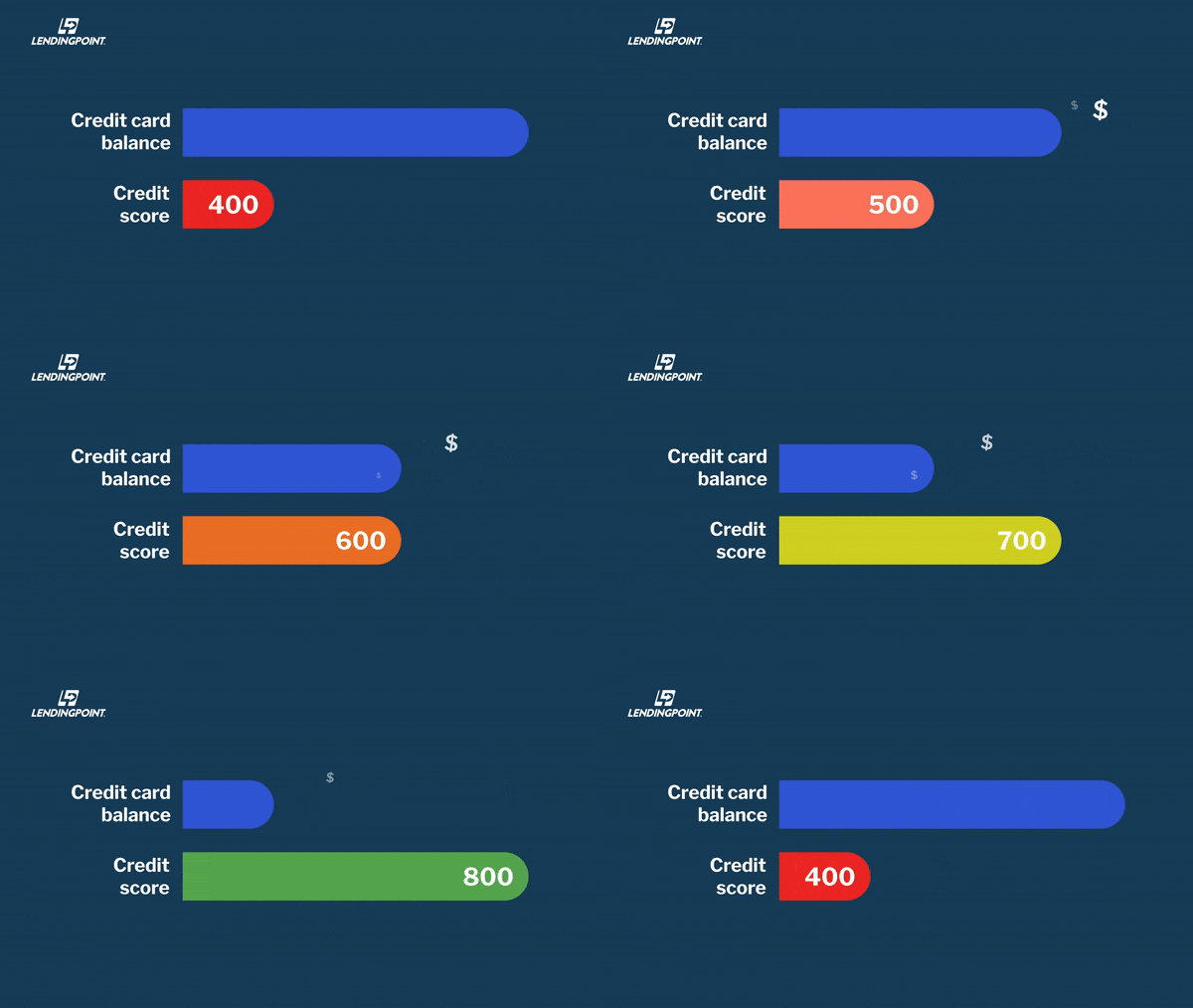
Your credit utilization ratio is the share of your available revolving credit that you’re currently using. It’s the largest component of the “amounts owed” category, which is 30% of your score.
FICO says that keeping utilization below 10%, alongside consistent on-time payments, can help you build and maintain a good FICO Score. Generally, lower is better — though not zero: a report showing no usage at all gives scoring models little to assess.6
Practical ways to bring it down:
- Pay more than once a month. Balances are typically reported once per statement cycle. Making a mid-cycle payment lowers the balance that gets reported, even if your spending hasn’t changed.
- Pay before the statement closes, not just before the due date. The statement closing date is usually what gets reported.
- Request a credit limit increase. A higher limit lowers utilization mathematically — but only if your spending stays flat. If a higher limit invites more spending, you’ve made the problem worse. Some issuers run a hard inquiry to review a limit-increase request, so ask before you submit it.
- Keep old cards open. Closing a card removes its limit from your total available credit, which can raise utilization overnight.
- Consider consolidating revolving debt. Moving credit card balances into a personal loan for debt consolidation converts revolving debt into an installment loan with a fixed payment and a definite payoff date. Because installment balances are treated differently from revolving balances, this can reduce your utilization ratio — though it only helps if you don’t run the cards back up.
For more approaches, see our guide to 10 methods to help pay off debt.
3. Never Miss a Payment
At 35%, payment history is the single largest factor in your score — and the one with the most downside risk. A single payment reported 30 days late can stay on your credit report for up to seven years.
The most reliable fix is automation: set up autopay for at least the minimum on every account, then pay more manually when you can. If cash flow timing is the problem, ask your card issuer or lender to move your due date to align with your pay schedule.
If you’re already behind, contact the lender before the account is reported late. Many have hardship programs, and a lender that works with you before delinquency is far more useful than one hearing from you afterward.
4. Build Length of Credit History
Length of credit history — 15% of your score — reflects how long your accounts have been open. A thin file makes it harder to qualify for credit, which is a genuine catch-22 for anyone starting out.
The CFPB points to a few ways in:7
- Secured credit cards. You put down a cash deposit, typically equal to your credit limit. That deposit reduces the issuer’s risk, which makes these easier to qualify for. As you build on-time history, you may be able to graduate to an unsecured card and get your deposit back.
- Credit-builder loans. You make small payments over six to 24 months and receive the full amount at the end. You build payment history and savings at the same time.
- Retail or store cards. Lower limits mean less room to overextend while you establish history.
The CFPB is equally clear about what doesn’t build credit: debit cards, prepaid cards, payday loans (even paid on time), and “buy here, pay here” auto loans, where dealers often report only negative information.7
Becoming an authorized user on someone else’s card is another route. When the primary account holder pays on time, that history can appear on your report too. Understand the risk in both directions: if the cardholder misses payments or runs up a balance, your credit takes the hit as well. Confirm the issuer reports authorized users to the bureaus before you rely on it.
One more thing that helps a thin file: think twice before closing your oldest account. Age of accounts is part of the calculation. Closing a card doesn’t immediately erase its history — FICO counts closed accounts too — but it does remove that card’s credit limit from your available credit right away, which can push your utilization up.
5. Get Credit for Rent and Utilities
Rent is most people’s largest monthly payment, and historically it didn’t do anything for their credit. That has changed.
Rental payment data now factors into newer FICO Score versions — FICO Score 9, 10, and 10 T — though notably not the older FICO versions still used in most mortgage lending (versions 2, 4, and 5).8
Options include asking your landlord whether they report to the bureaus, using a free service like Experian Boost, or using a paid rent-reporting service. Coverage varies: some report to all three bureaus, others to only one or two.8
One caution: reporting cuts both ways. Late rent payments can be reported alongside on-time ones, and some services will add past payment history. If your rent record isn’t consistently on time, this may not help.
6. Understand Hard vs. Soft Credit Inquiries
New credit is 10% of your score, and hard inquiries are the mechanism. But the impact is routinely overstated.
According to FICO, a single additional hard inquiry takes fewer than five points off most people’s scores. Inquiries stay on your credit report for up to two years, but only affect your FICO Score for one year.9
The distinction that matters:
- Soft inquiries — checking your own score, prequalification offers, background checks — have no effect on your score.
- Hard inquiries — submitting a formal credit application — can have a small, temporary effect.
Two things follow from this. First, checking your own credit as often as you want won’t affect your score. Second, if you’re shopping for a mortgage, auto loan, or student loan, do it in a concentrated window. For those three loan types, FICO groups multiple same-type inquiries as a single inquiry — within 14 days in older score versions, within 45 days in the newest — and disregards any such inquiries made in the 30 days before the score is calculated. This grouping applies to mortgage, auto, and student loan shopping; it doesn’t extend to credit card applications.9
The takeaway isn’t “avoid applying for credit.” It’s “apply deliberately.” Where a lender offers prequalification with a soft credit check, you can see estimated rates and terms without a hard inquiry. Prequalification isn’t a loan approval, and final terms may differ; submitting a full application typically results in a hard inquiry. See our explainer on hard vs. soft credit checks.
7. Know Which Score a Lender Is Actually Using
There’s no single credit score. There are dozens of models and versions, and the one a lender pulls may not be the one you see in your banking app.
Two developments worth knowing about in 2026:
Mortgages are transitioning to newer models. The scores behind mortgage decisions are changing, but slowly. Fannie Mae and Freddie Mac now let all approved lenders use either Classic FICO or VantageScore 4.0. FICO 10 T has been approved, and historical scores were published in July 2026, but lenders can’t yet use it for loans sold to Fannie Mae or Freddie Mac.10
Buy now, pay later is entering the picture. In June 2025, FICO announced two new models that incorporate buy now, pay later loan data, FICO Score 10 BNPL and FICO Score 10 T BNPL.11 These are separate, opt-in models rather than a change to the standard score. On the standard score, myFICO states that its understanding is that none of the three major bureaus currently feed BNPL account data into FICO Score calculations.12 The direction of travel is clear even if the timing isn’t: if you use BNPL regularly, expect that repayment behavior to matter more over time, and treat those installments like any other credit obligation.
The practical implication: don’t be alarmed by small differences between scores from different sources. Focus on the underlying behaviors, which every model rewards.
Frequently Asked Questions
It depends on what is driving the score. Utilization changes can show up within one or two statement cycles, since balances are reported monthly. Payment history takes longer — you’re building a track record. Negative marks like a 30-day late payment or a collection can remain for up to seven years, though their effect fades as they age.
Once a week from each of the three nationwide bureaus, through annualcreditreport.com. This weekly access is permanent.4
No. Checking your own credit is a soft inquiry and has no effect on your score.9
FICO says keeping utilization below 10%, with consistent on-time payments, can help you build and maintain a good score. Generally, lower is better — but not zero: a report showing no usage at all gives scoring models little to assess.6
No. Income isn’t a factor in credit scoring models, though lenders may consider it separately when evaluating an application. It’s a common point of confusion: in FICO’s Spring 2026 report, 67% of consumers either believed income directly affects credit scores or were unsure.1
Usually not. Closing a card removes its credit limit from your total available credit, which can raise your utilization ratio immediately. Its effect on credit history length is slower and often misunderstood: FICO considers the age of closed accounts too, so closing a card doesn’t erase its history. The account typically drops off your report about ten years later, and only then does it stop counting toward your length of credit history.
Usually not, on its own. According to myFICO, the major bureaus don’t currently feed BNPL data into standard FICO Score calculations.12 FICO has released separate BNPL-inclusive models, and a missed BNPL payment that goes to collections can affect your score.11 Treat BNPL installments as real credit obligations.
Typically fewer than five points, and only for a year.9
Take Control of Your Credit Score
Improving your credit score is rarely dramatic. It’s the accumulated result of a handful of habits: paying on time, keeping balances low relative to your limits, letting accounts age, and applying for new credit deliberately rather than reactively.
Start with the one step that costs nothing and takes fifteen minutes — pull your credit reports and read them. Then pick the factor with the most room to improve and work on that.
Explore more ways to strengthen your financial footing in our Knowledge Center, including how to create a budget you can stick to.
Sources
- “FICO® Score Credit Insights Report: Average FICO Score Dips to 714,” March 24, 2026, FICO
- “How Lenders Use Credit Scores,” accessed September 8, 2026, myFICO
- “What’s in my FICO® Scores?” accessed September 8, 2026, myFICO
- “Free Credit Reports,” July 31, 2026, Federal Trade Commission
- “Credit Checkup: Improving the Accuracy of Credit Reports,” April 30, 2024, Consumer Reports
- “What Should My Credit Utilization Ratio Be?” accessed September 8, 2026, myFICO
- “What are some ways to start or rebuild a good credit history?” September 13, 2024, Consumer Financial Protection Bureau
- “How to Add Rent Payments to Your Credit Reports,” accessed September 8, 2026, myFICO
- “How Do Credit Inquiries Affect Your FICO® Score?” accessed September 8, 2026, myFICO
- “Credit Scores,” October 2, 2026, Federal Housing Finance Agency
- “FICO Unveils Groundbreaking Credit Scores That Incorporate Buy Now, Pay Later Data,” June 23, 2025, FICO
- “Does Buy Now Pay Later Affect FICO® Scores?” accessed September 8, 2026, myFICO


