

Personal Loans vs. Balance Transfers: The 2026 Guide
Written by LendingPoint Editorial Team
If you’re carrying high-interest credit card debt, two of the most common ways to reduce interest are personal loans and balance transfer credit cards.
Both options can help—but they work very differently and come with distinct trade-offs. In today’s higher-rate environment, the best option is the one you can realistically pay off on time, without fees or surprise rate increases.
With average credit card interest rates hovering around 19.7%, carrying a balance has become increasingly expensive. Tighter credit approvals and higher borrowing costs mean choosing the right payoff strategy matters more than ever.
This guide explains how personal loans and balance transfers work, the risks to watch for, and how to decide which option fits your situation.
Quick Answer
- Choose a personal loan if you want a fixed payment and a clear payoff date.
- Choose a balance transfer if you can fully pay off the balance during the 0% promotional period and absorb the transfer fee.
- Not sure? Compare total cost (interest + fees) and choose the option you can manage reliably.
What Is a Personal Loan?
A personal loan is a fixed-rate installment loan you can use to pay off credit cards and other debts. You then make one monthly payment until the loan is fully repaid.
Key Features of Personal Loans
- Fixed interest rate that does not change over the loan term
- Fixed monthly payment
- Set payoff date
- No revolving balances
Personal loans turn credit card debt into a structured, predictable repayment plan.
What Is a Balance Transfer?
A balance transfer moves existing credit card balances to a new credit card with a low or 0% introductory interest rate. These offers typically require good-to-excellent credit and vary by issuer.
A balance transfer can temporarily stop interest from accruing, but only if you qualify and pay the balance off before the promotional period ends.
Key Features of Balance Transfers
- Promotional 0% or low APR (usually 12–18 months)
- Requires strong credit
- One-time transfer fee applies
- Interest rate often increases after the promo ends
What’s Different Right Now: Rates, Fees, and Promo Windows
In a higher-rate environment, credit card interest can grow quickly, especially if you’re carrying a balance. While balance transfer cards may offer short-term relief, transfer fees and shorter promotional periods can change the math.
That’s why it’s important to compare total cost, not just the advertised rate.
- Average credit card APRs on accounts that carry a balance often exceed 20%
- Many cards charge 3%–5% balance transfer fees
- Promotional periods are generally shorter than in the past
As a result, the cost difference between these options has become more meaningful.
Personal Loans vs. Balance Transfers: Side-by-Side Comparison
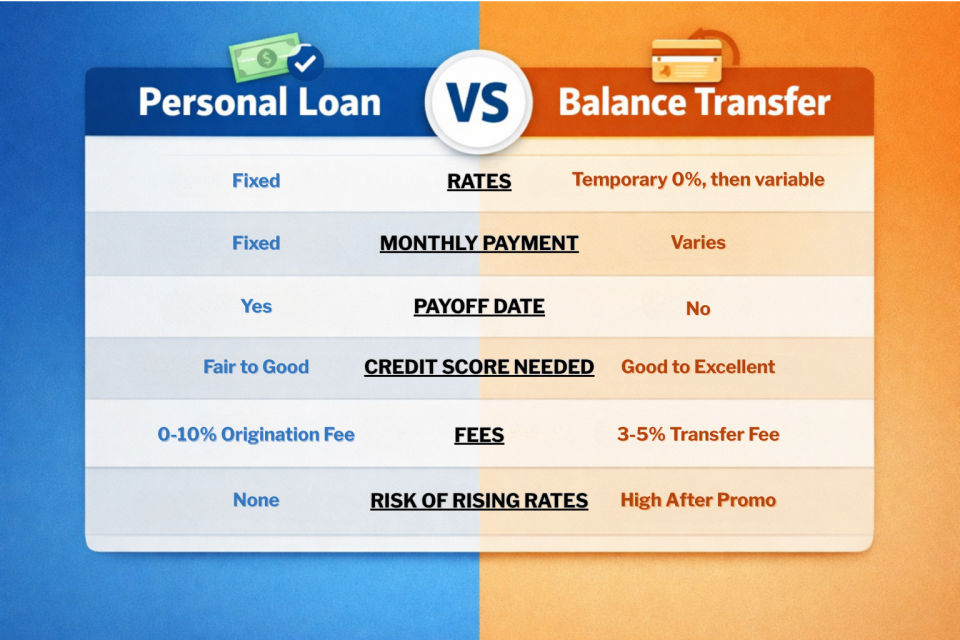
Which Option Is Better for Your Credit?
How Personal Loans Can Help Your Credit
- Lower credit card utilization
- Create predictable payments
- Prevent balances from growing again
How Balance Transfers Can Help Your Credit
- Temporarily stop interest
- Keep debt on revolving credit
However, once the promotional rate expires, the interest rate can spike—potentially increasing total debt if the balance isn’t paid off.
When a Personal Loan Is the Better Choice
A personal loan is often a better fit if:
- You have multiple credit cards
- You want a clear payoff timeline
- Your credit is fair or improving
- You need stability and structure
A personal loan consolidates scattered balances into one manageable obligation.
When a Balance Transfer Makes Sense
A balance transfer may be a good option if:
- You have excellent credit
- Your total debt is relatively small
- You can pay it off within the promotional period
- You won’t use the card for new purchases
Without discipline, a balance transfer can become a temporary fix that leads to higher costs later.
The Hidden Risk of Balance Transfers
Many people fall into this cycle:
-
-
- Transfer debt to a new card
- Resume using old cards
- End up with more total debt
- Promotional rate expires
- Interest charges spike
-
Personal loans reduce this risk because credit card balances are paid off upfront and the loan balance only moves in one direction—down.
How to Choose the Right Option
Ask yourself:
- Can I realistically pay this off within 12–18 months?
- Do I want a fixed monthly payment?
- Do I qualify for promotional credit?
- Will I avoid running up new balances?
Your answers will point you toward the most sustainable solution.
Frequently Asked Questions
What is the difference between a personal loan and a balance transfer?
A personal loan is an installment loan with a fixed interest rate and fixed monthly payment, repaid over a set term. A balance transfer moves credit card debt to a new card with a low or 0% introductory APR for a limited time, after which it usually switches to a variable rate.
Which is better for paying off credit card debt?
A personal loan is often better if you want predictable payments, a clear payoff date, or need to consolidate multiple cards. A balance transfer can work if you have strong credit and can fully repay the balance during the promotional period.
Do balance transfers hurt your credit score?
A balance transfer may cause a small, temporary dip due to a credit inquiry and new account. Over time, it can help if it lowers utilization and you make all payments on time.
Do personal loans hurt your credit score?
A personal loan may also cause a temporary change from a credit inquiry and new account. It can help over time if it reduces credit card balances and payments are made on time.
What are typical balance transfer fees?
Most balance transfer cards charge a one-time fee of 3%–5% of the amount transferred. Fees vary by issuer and offer.
What happens when a 0% promotional period ends?
Any remaining balance typically begins accruing interest at the card’s regular APR, which can significantly increase total cost if the debt isn’t paid off.
How do I choose between a personal loan and a balance transfer?
Compare total cost, including fees and interest, and choose the option you can manage consistently. Fixed payments and a set payoff date often favor a personal loan, while strong promotional offers may make a balance transfer effective for short-term payoff.
Final Thoughts
The right choice isn’t about chasing the lowest advertised rate—it’s about choosing the option that helps you actually get out of debt.
- Balance transfers can provide short-term relief.
- Personal loans offer long-term stability.
The best solution is the one that fits your income, your credit profile, and your ability to stay disciplined.
Disclaimer: This content is provided for informational and educational purposes only and is not intended as financial, credit, or legal advice. The information presented is general in nature and may not reflect your individual financial situation. Credit products, including personal loans and balance transfer credit cards, involve different features, costs, and risks. Rates, fees, terms, eligibility requirements, and promotional offers vary by lender and are subject to change. Approval is not guaranteed and is based on creditworthiness and other factors.
Statements regarding potential benefits—such as payment predictability, interest savings, or credit score impacts—are not guarantees of future results. Credit score outcomes depend on multiple factors, including payment history, credit utilization, total debt, and individual credit profiles. Consumers should carefully review all loan agreements, credit card disclosures, and applicable terms before making a financial decision. Consider comparing total costs, including interest and fees, and evaluating your ability to repay before choosing a debt repayment option.


